PLANTING TREES FOR FALL COLOR

IMG_1557.PNG

PLANTING TREES FOR FALL COLOR

The beauty of fall colors touches the soul. Take time to pause and enjoy this special time of year.  The reds, yellows, and oranges of trees in the fall all add to the fall splendor.

Here are some Natural Plus favorites for adding fall colors to your yard/landscaping:

Ornamental/Smaller Trees with Fall Color (10-30’ size):

·      Amur Maple           Brilliant red fall color, clump or single stemmed

·      Serviceberry          Orange/reds , berries for birds, clumps or singles

·      Hot Wings               Reds/oranges with bright red seed pods


Larger Shade Trees with Good Fall Color (over 30’)

·      Aspen                                               Quaking golden yellow leaves

·      Birch                                                 Yellow, clump or single stemmed

·      Ginkgos                                            Golden yellow (slow growing)

·      Lindens                                            Yellow, heart shaped leaves

·      Locust                                               Yellow wispy leaves

·      Maples: Autumn Blaze               Brilliant Red, fast growing

·      Maples: Burgandy Belle                    Burgundy Red

·      Maples: Emerald Luster                    Golden Yellow, fast growing

·      Maples: Rubrum                           Bright Red

·      Maples: Sugar                                Multiple varieties – oranges, reds, yellows

·      Red Oaks                                         Red

·      Witch Hazel                                      Fragrant yellow blooms in fall

PIVOTING TO MAKE THIS WORK FOR OUR FAMILY

Over 5 years ago, when we decided to purchase Natural Plus we had NO CLUE what we were doing or what we were getting ourselves in to.

And to be honest, we still don't. 😂

But does anyone, really??

Aren't we all doing the best we can, making mistakes along the way, but then learning from them and growing and choosing better next time? 

When we bought the nursery, Dave’s dad Dave was running a landscaping crew and doing big commercial landscaping projects. We slowly inherited and took over operations of the crew and jobs in 2014 and 2015, however quickly realized it was more than we wanted to manage and more time consuming than we liked. We originally decided to purchase the business for the flexibility of working our jobs around our family. The demands of the landscaping crew, the appointments, the estimating, and the billing alone were more than Dave was able to handle himself, and keeping him busy all day and every evening, plus working the nursery on the weekends. He was falling more and more behind on everything because he was filling too many roles. We had to make a decision: get more help and grow the landscaping, or phase out that part of the business and focus on the retail nursery. We had a lot of deep discussions and spent hours projecting if a seasonal retail nursery could stand alone without the income from landscaping. We are excited to say that we {mostly} went for it, only doing a select few small landscaping projects that were still hanging on from previous years. We are continuing to trust in the process and take risks, choosing to pour in to the parts of this business that work for our family, and letting go of the parts that don’t. It’s been a long, slow process, and will probably never be complete. And it is oh so scary, not knowing if what we follow will continue to provide for our family and make our business profitable. We continue to have challenges, but choose to trust the process of it all, and know that we need to continue to make decisions for our business based on what we want for our family.

Business ownership has taught us so much in the last 5 years, but the thing we have gotten the most from it is THE PEOPLE. Our customers are the absolute best, and continue to SHOW UP and SUPPORT the little backyard nursery we have going here. 

We appreciate all of you, and thanks for sticking with us as we grow and learn how to make this family business work for us.

Screen Shot 2018-10-09 at 1.57.34 PM.png

Planting Shrubs for Fall Colors

IMG_1288.PNG

Planting Shrubs for Fall Colors

The beautiful, spectacular colors of fall are good for the soul!  They will cause one to stop and pause and enjoy the season. 

If you would like to include some shrubs in your landscaping that turn beautiful fall colors, these are some Natural Plus favorites:

·      Burning Bush (euonymous alatus): Burning bush come in 2 size ranges: dwarf (grow 5-6’ tall) and standard (grow 8-10’ tall). Bushes turn brilliant scarlet red in the fall. They can also be identified by the bark that is square and corky in appearance.

Burning bush starting to turn

Burning bush starting to turn

·      Sumac: There are several varieties of sumac including Staghorn, Cutleaf, and Tiger Eyes. All 3 varieties turn brilliant red or oranges in the fall. Tiger Eyes have a limegreen/yellow color during the summer months. In the fall, staghorn sumac can often be seen along roadways in large groupings of brilliant red.

·      Compact Amur Maple: These have brilliant red fall color and grow about 5-6’ tall. They are the dwarf variety of standard size Amur Maples.

IMG_1286.JPG

·      Viburnums (Cranberries) – There are many varieties of viburnums, growing from 3 to 15 feet depending on the variety.  Some of the most common varieties are Bailey Compact, Blue Muffin, Redwing, and Wentworth. All turn beautiful shades of burgundy, red, or oranges in the fall.  The berries they produce are also colorful in shades of blue, red, and oranges – favorites of migrating birds.

Viburnum

Viburnum

·      Cotoneaster and Aronia – Both turn beautiful shades of burgundy or reds.  They also produce abundant berries that are pretty and provide food for migrating birds. Aronia berries have recently grown in popularity for human consumption.  They are grown, harvested and sold as a healthy dietary antioxidant.  

Spireas and Barberries : Spireas and barberries come in many sizes and varieties. Spireas are primarily planted for their summer blooms, and barberries are typically planted for their burgundy summer leaf color. However, both give an added bonus of turning to beautiful fall colors of reds, burgundy, oranges, and yellows.

VINES

IMG_0794.PNG

VINES

Ornamental vines can add interest and privacy to your landscaping. At Natural Plus we carry a nice selection of vines and can help you choose the right vine for the right place.

 Most vines require a sturdy trellis, arbor, or fence to grow on. At Natural Plus we also carry a large selection of sturdy metal arbors and trellises if you need one. 

 Below are some options you can consider for vines.

·      Clematis – Clematis come in colors of purple, white, magenta (above picture), etc.   Jackmann, which is deep purple, is a favorite of many people. Sweet Autumn has small white prolific very fragrant blooms in August/September. Clematis prefer sun or part sun and grow app 8-12 feet in length.

A honeysuckle vine growing on a trellis on the west side of my home.

A honeysuckle vine growing on a trellis on the west side of my home.

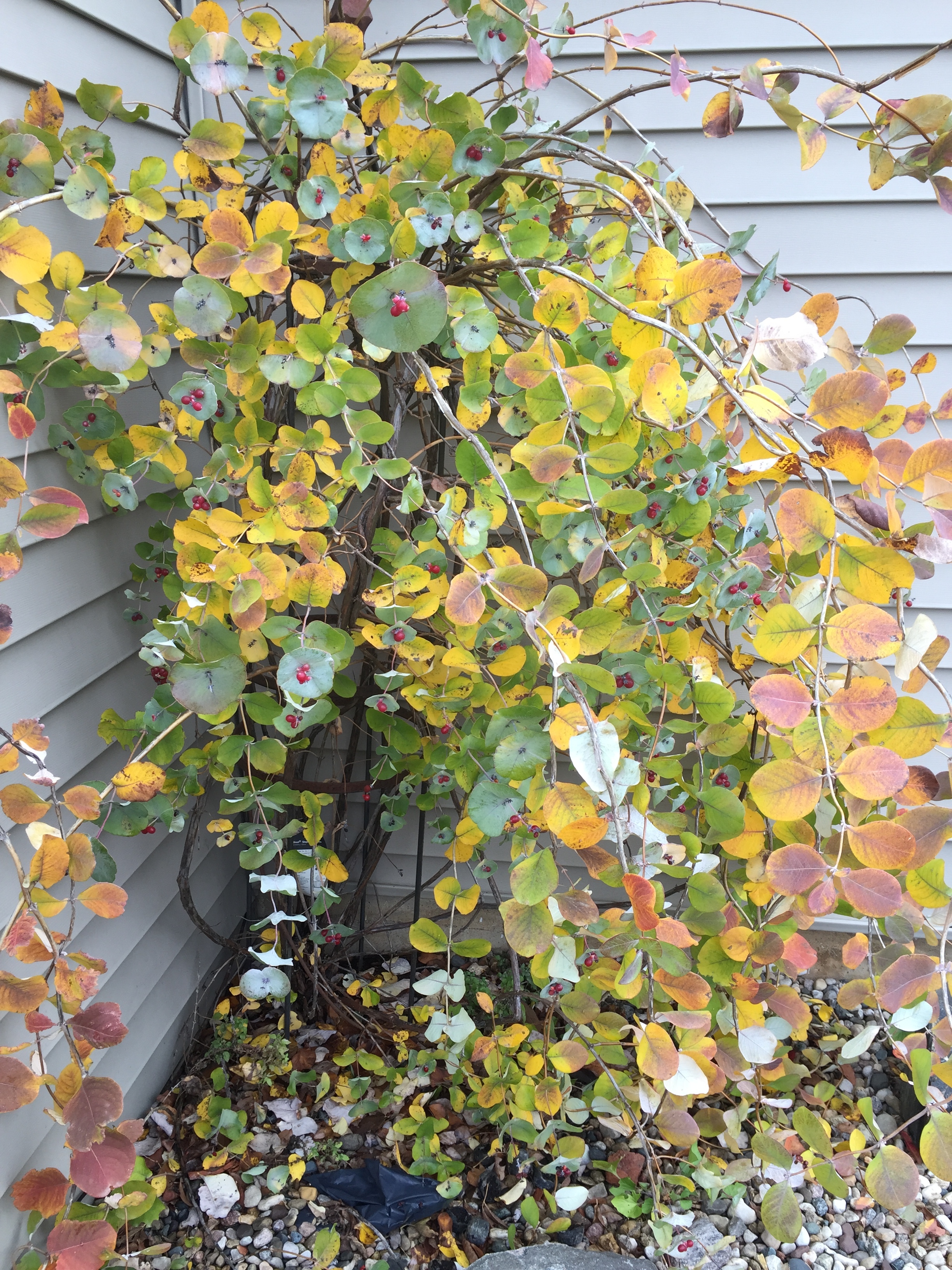
·      Honeysuckle Vines: 2 of our favorites are Kinzleys Ghost and Dropmore. Both do well in sun or part sun, are easy to grow, and grow about 8-12 feet in length.  They do tolerate a considerable amount of shade. The foliage on Kinzleys Ghost resembles eucalyptus with rounded yellow striking blooms. (Check out the Kinzley’s Ghost at Natural Plus now in full bloom.) Dropmore Honeysuckle has orange tubular blooms mid-summer – a favorite of hummingbirds.

·      Wisteria- Wisteria is a very hardy, vigorous vine that will grow 20-30’. They bloom in June with long dangling purple blooms. They prefer full or part sun. (Come and check out the Aunt Dee Wisteria on the old windmill frame at Natural Plus! When it blooms it is stunning!)

Boston Ivy on the small brick building at Natural Plus

Boston Ivy on the small brick building at Natural Plus

·      Boston Ivy – Boston Ivy is one of the few vines that grow best on brick or concrete walls. Foliage is deep green with red fall color. Boston Ivy is commonly seen on older brick homes covering entire sides of the houses.

·      Bittersweet – Bittersweet vines produce orange berries in the fall. Vines can be cut and berries remain intact to make beautiful fall arrangements. Previously a male and female vine was required to produce berries, but nurseries now sell both in one pot.

D28A3C39-F6DA-44C6-9491-E4B082D5D04B.JPG

·      Climbing Roses – John Cabot is a deep red climbing rose blooming mid-summer. Bonica is a prolific bloomer with pink blooms. Vines grow about 8-12’.  All roses prefer full sun.

There are many more options of vines available. We can help you choose the right vine for your situation.

Adding a vine covered arbor as an entrance to your garden is a beautiful way to invite guests to your garden or home!