trees north iowa

ROSES

An old proverb sums it up –

“Take time to smell the roses.”

The beauty and fragrance of a rose makes us stop for a minute to enjoy life.

Growing your own roses can be a challenge but here are a few tips to help you be successful.

Tea roses are not hardy for our zone. Years ago they were our only option. They required a lot of care and winter protection and still did not fare well over winter. Knock Out Roses were marketed as hardy for our area but they do require a protected spot and are still susceptible to hard winters.

At Natural Plus we carry a few varieties of roses that are much more hardy, disease resistant, and rebloom. Here are some of those varieties:

Easy Elegance Roses : Easy Elegance roses are very hardy, highly disease resistant, and colors are stunning. Some varieties that we carry include:

            Coral Cove – Coral colored, everblooming, grows 24”

            High Voltage – Bright yellow, recurrent blooms, grows 3-5’

            Kashmir – Dark red tea like blooms, grows 2 ½-4’

            Music Box – Stunning yellow and pink blend, grows 3’

            Paint the Town – Everblooming, medium red, grows 2-3’

Nearly Wild – Nearly wild roses are one of our most hardy varieties. They bloom all summer. Blooms resemble the bloom of a wild rose. If there is a particularly hard winter, they usually come back from the root. Grow 2-3’

Purple Pavement –Purple pavement is a rugosa rose with fuschia colored blooms that grow in clusters.  They are very fragrant and plants are extremely hardy. Blooms turn to beautiful red “rose hips” in fall.  Grow 3-5’. Lotty’s Love is smaller variety of this rose.

Climbing Roses: At Natural Plus we carry 2 varieties that we feel are the most hardy: William Baffin is a prolific bloomer with medium pink blooms.  John Cabot is a deep red colored. These require a trellis.

 Care of Roses

Roses need full sun to get optimal blooms. Adequate watering, usually 2-3 times a week is a must, especially for newly planted roses. It is also advisable to treat with a “Rose RX -3 in One” rose care product. This product provides protection from aphids, spider mites, black spot fungus, and powdery mildew. It is listed as organic.

 Fertilize roses 2-3 times a summer starting in late May with an all purpose fertilizer such as “Miracle Gro” or “Rapid Gro”.

 Trimming Roses

Best time for trimming roses is early spring before they leaf. Trim to the desired size. After they leaf, trim out any dead wood that remains.  They can be lightly trimmed during the summer to achieve optimal shape.

Overwintering Roses

Care over winter is a must. Be sure that roses are adequately watered going in to winter. Water once a week in the fall up until the ground freezes. Mulch roses heavily at the base in the fall. This also helps protect from winter kill.

Mike's Top 5 Plants

What makes you LOVE a certain plant? Do you look for COLOR? Texture? The shape? Do certain plants have special meaning for you? Or maybe you have memories of plants that your grandparents had in their yard growing up?

All of us here at Natural Plus love helping you find the perfect plants for your yard that you will love for years to come. And, after being in business for 42 years, we have figured out what plants do well and are our favorites!

If you’re in the market for some new trees, shrubs, or perennials, you’re going to want to follow along with these blog posts, I’ll be sharing each of our top 5 favorite plants with all of you!

Next up is Mike Watson, who has been employed at Natural Plus for 36 years. He is drawn more towards trees because they are stately and he enjoys the longevity.

And now here are Mike’s top 5 plant picks:

  1. Gingko: It’s one of the oldest trees known. It has few pests and problems. Nice yellow fall color and once you get a freeze the majority of the leaves drop within 24 hours.

    Fun fact: Mike’s license plate used to say GINGKO

Photo from Nature Hills Nursery

Photo from Nature Hills Nursery

2. White Oak: because of the beautiful fall red color

image from Bailey’s Nursery

image from Bailey’s Nursery

3. Weeping White Spruce: it’s very tall and narrow and unusual, takes up little space

photo from monrovia.com

photo from monrovia.com

4. Kentucky Coffeetree: Mike loves the picturesque branching habit that is highlighted in wintertime, native to parts of Iowa

Photo from The Morton Arboretum

Photo from The Morton Arboretum

5. Shagbark hickory because of the interesting bark

image from Illinois Wildflowers

image from Illinois Wildflowers

And, in case you missed it, here are owner Dave’s Top 5 Plant Picks.

WHAT’S NEW FOR TREES

WHAT'S NEW FOR TREES.jpg

What’s NEW for Trees

The number of new varieties of plants coming on the market is literally exploding!! We struggle to keep up with all of the new options. Growers are propagating new varieties of old favorites that are now more disease resistant, less finicky about watering, grow faster, bloom longer, have more vibrant colors, and are dwarf versions of the parent plants.

At Natural Plus we carry a large collection of some of these newer varieties, as well as the “old favorites”.  Here are a few of the newer varieties that might interest you:

 Shade/Larger Trees:

Elms – Elms are back! The elms that survived Dutch Elm Disease have now been propagated and are resistant to Dutch Elm Disease. Elms have a beautiful upright vase shape and would add a nice option to your yard.

Maples– Some maples are selected for fast growth, some for vibrant fall colors, etc. Many of these have now been crossed and have both characteristics. Some newer varieties of maples include:

Autumn Blaze: A cross between a silver and red maple. Upright growth. Vibrant red fall color. Fast growing but not as sturdy as hard maples.

Brandywine: A cross between October Glory and Autumn Flame. A small seedless maple (25’). Outstanding fall color from red to red/purple.

Burgundy Belle: Oval shape. Grows to 45’. Fall color brilliant red changing to intense burgundy.

Fall Fiesta Sugar Maple: Leathery green leaves, resistant to sun scald and frost cracks. 50-75’. Fall color oranges and reds.

Red Sunset:  2000 Tree of the Year, A Rubrum Maple, upright, brilliant red fall color, grows 50’

Magnolias – We are offering some varieties this spring that are hardy for our zone:

Royal Star: Small tree 10-15’, Small white fragrant blooms spring

Gold Star: Grows 20-30’, Light yellow flowers spring

Sunburst: Grows 30’, Lemon yellow flowers spring

Crab trees add spring color to your landscape

Crab trees add spring color to your landscape

Smaller/Dwarf Trees:

 For people with small spaces, there is now a wider selection of dwarf trees.

Crabs are now resistant to Cedar Apple Rust (which caused the trees to lose their leaves mid-summer). The apples are very small and will be cleaned by birds.  Some newer selections of crabs include :

Camelot: A very small crab with blossoms changing from red buds to pink to white, very small berries, grows 10’

Prairie Fire: One of the deepest pink/red blooms, small berries, 15-20’

Royal Raindrops: Burgandy red foliage with deep pink blossoms, grows 20’

 Tree Hydrangeas : These are basically a hydrangea bush on a stem and grow only 8-12’ tall! We carry several varieties including:

Limelight: Lime green/white large blooms in summer, grows 8’

Quick Fire: Large white blooms turning deep pink/red, grows 6-8’

Vanilla Strawberry: Large white blooms turning pink, grows 6-8’

Tree Lilacs: These are basically a Dwarf Korean Lilac or a Miss Kim Lilac on a stem. These will bloom in early June and the fragrance will fill your entire yard.  Grow 5-6’.

Read more about what we recommend for SPRING FLOWERING TREES.  

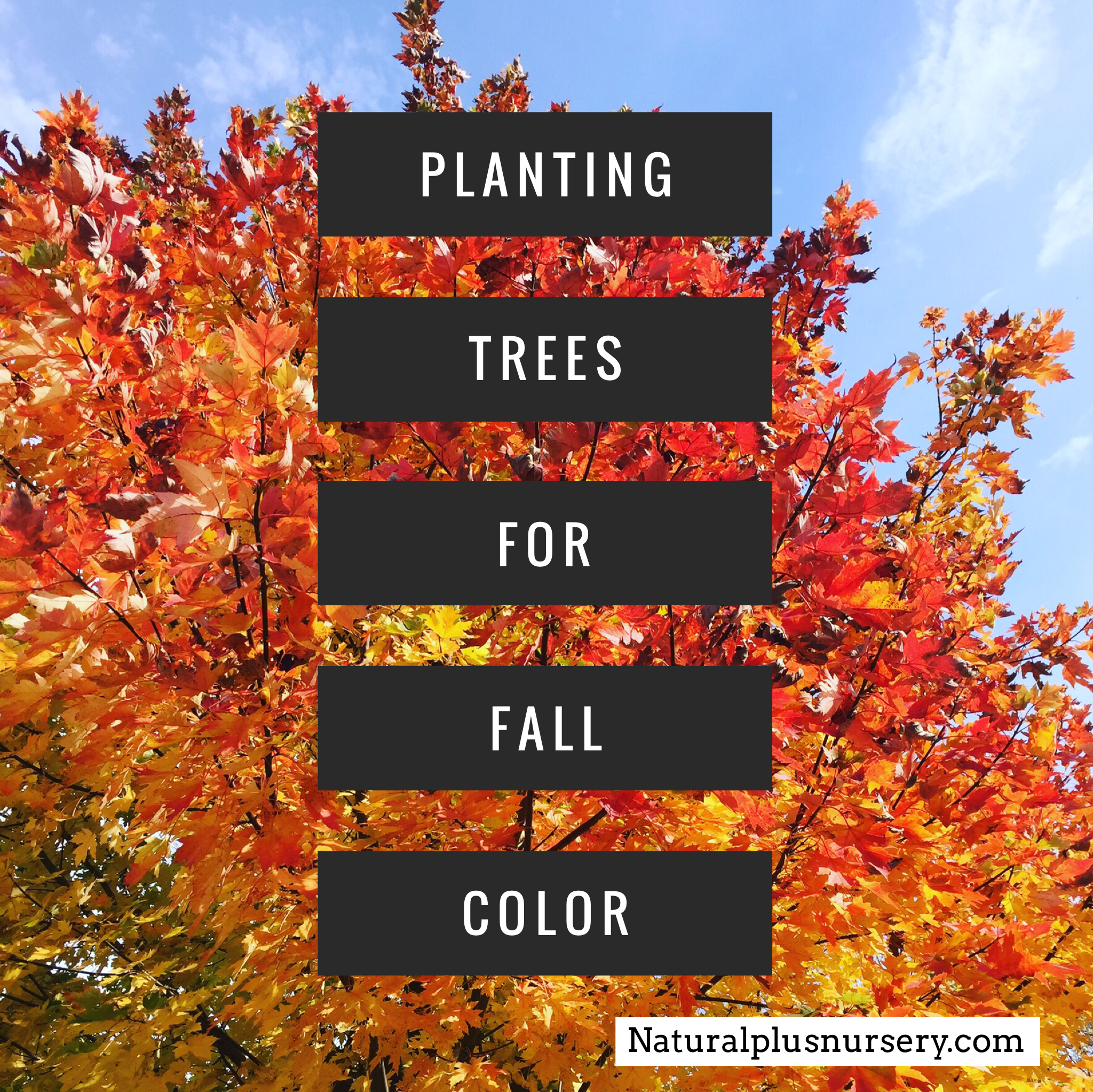
PLANTING TREES FOR FALL COLOR

IMG_1557.PNG

PLANTING TREES FOR FALL COLOR

The beauty of fall colors touches the soul. Take time to pause and enjoy this special time of year.  The reds, yellows, and oranges of trees in the fall all add to the fall splendor.

Here are some Natural Plus favorites for adding fall colors to your yard/landscaping:

Ornamental/Smaller Trees with Fall Color (10-30’ size):

·      Amur Maple           Brilliant red fall color, clump or single stemmed

·      Serviceberry          Orange/reds , berries for birds, clumps or singles

·      Hot Wings               Reds/oranges with bright red seed pods


Larger Shade Trees with Good Fall Color (over 30’)

·      Aspen                                               Quaking golden yellow leaves

·      Birch                                                 Yellow, clump or single stemmed

·      Ginkgos                                            Golden yellow (slow growing)

·      Lindens                                            Yellow, heart shaped leaves

·      Locust                                               Yellow wispy leaves

·      Maples: Autumn Blaze               Brilliant Red, fast growing

·      Maples: Burgandy Belle                    Burgundy Red

·      Maples: Emerald Luster                    Golden Yellow, fast growing

·      Maples: Rubrum                           Bright Red

·      Maples: Sugar                                Multiple varieties – oranges, reds, yellows

·      Red Oaks                                         Red

·      Witch Hazel                                      Fragrant yellow blooms in fall