What's Blooming

Weigelas take center stage

weigelas.png

Just when the spring bloomers are starting to wane, another beautiful plant takes center stage – Weigelas.

These early summer bloomers have beautiful pink or red tubular blooms.  Many new varieties have recently come on the market. These new varieties come in multiple sizes and have various leaf colors including green, burgundy, and yellow.  Weigelas grow best in full or part sun.

Here are a few varieties that we carry here at Natural Plus:

  • Dark Horse- grows 3’, pink blooms, burgundy/bronze leaves

  • Golden Jackpot – grows 4-6’, pink blooms, yellow leaves

  • Minuet- grows 2-3’, pink blooms , green leaves with purple casts

  • Pink Sonic Bloom – grows 4-5’, green leaves, bright pink blooms

  • Rainbow Sensation- grows 4’, pink blooms, variegated leaves

  • Red Prince – grow 5-6’, bright red blooms, deep green leaves

  • Rumba – grow 3’, dark red flowers with a yellow throat, bronze-purple tinged leaves 

  • Spilled Wine – 1-2’ tall, 2-3’ wide, magenta blooms, red wavy leaves

  • Wine and Roses -  grow 4-5’, burgundy/bronze leaves, rosy pink blooms


Things You Might Not Know About the Renaissance Spirea

Things you might not know about the Renaissance Spirea

Things you might not know about the Renaissance Spirea

Blooming now – Renaissance Spirea (commonly known as Bridal Wreath Spirea)

These graceful spireas got their common name as they were the flower of choice for June brides a couple generations ago. At that time, other flower choices were limited or none - so this graceful plant became the bouquet of those June brides.

 Although not often a choice for brides now, we still enjoy these plants and their graceful cascading white blooms. They look especially beautiful – making a historical statement -when planted around Victorian type homes.

Photo from monrovia.com

Photo from monrovia.com

Renaissance spireas typically grow 6-7’ tall and wide. Allow plenty of space for them to spread out. They prefer full or part sun but will even grow in nearly full shade.

If you do not have enough space for one of these beauties, smaller varieties have been developed and are now available. These newer “cousins” include:

·      Snowmound – a similar plant and bloom but grows 3-5’ tall

·      Birchleaf Spirea- these have a similar bloom, but leaves are blue green and resemble eucalyptus leaves – grow 2-3’

Our Top 3 Flowering Crab Tree Picks

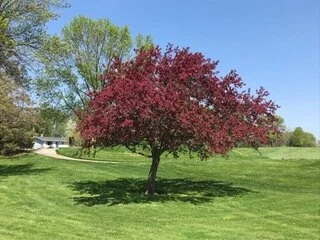
One of the rewards for living through long Iowa winters is the delight of spring blooming flowering crab trees.

If you have memories of flowering crab trees that dropped very large apples, or that lost all their leaves by the end of June – No Worries!  New varieties of crabs no longer have these characteristics. They have either no berries(apples) or very small berries that birds will clean. The old varieties that lost their leaves by July were susceptible to a disease called cedar apple rust fungus. New varieties are resistant to this as well.

Our Top 3 Flowering Crab Tree Picks

Spring Snow -  Deep green foliage with white blooms, fruitless, Grow 12-15’ 

IMG_8147.jpeg

Prairie Fire – Green foliage with the deepest red/pink blooms currently available, small berries that birds will clean, grow 20-25’ 

IMG_8133.jpeg

Camelot – A wonderful dwarf variety. Buds deep pink with blooms pink fading to white along the entire stems of the tree, small berries that birds will clean, grow 10-12’

More on Crab Trees HERE.

What You Need to Know About Rhododendrons

If you notice a bush blooming now with bright lavender-purple blooms it is most likely a rhododendron. Even though blooms only last 1-2 weeks, these early spring bloomers add a touch of spring delight as we wait for the other spring bloomers to emerge.

Two varieties of rhododendron do well here in North Iowa. They are PJM and Ramapo.  PJM’s grow 3-5 feet tall, Ramapo’s  grow 2-3’.

 Another characteristic of rhododendrons is that they have “broad” leaves that do not drop in the fall. Leaves hold on and turn a mahogany brown/green during winter.

The ideal location for rhododendrons is on an east or north side of a building where it is more shaded from bright afternoon winter sun that can winter burn the broad leaves. However, this year we have noticed rhododendrons thriving on the south and west sides, and even in the middle of yards where there is no protection.

Care for rhododendrons is relatively easy. Water twice a week the first season. After the first season, water once a week if rain is inadequate. Fertilize with “Miracid” fertilizer 2 or 3 times in early and mid-summer. Trim or shape bushes early summer after blooming. (Blooms set on plants in the late summer and fall – so late trimming will simply trim off next spring’s blooms.)